


What is a pipe straightening machine?
The straightening machine changes the straightness of materials like bars by applying pressure through straightening rolls. Typically, there are two rows of straightening rolls, with varying numbers. There are also two-roll straightening machines that use the angle changes between two rolls (with a concave center and hyperbolic shape) to straighten materials of different diameters. The working principle of the straightening equipment involves positioning the rolls at an angle relative to the direction of the material's movement. Two or three large active pressure rolls are driven by an electric motor to rotate in the same direction, while several smaller passive pressure rolls on the other side rotate due to the frictional force from the rotating round bars or pipes. To achieve the required compression, these small rolls can be adjusted forward or backward simultaneously or individually. Generally, the more rolls there are, the higher the precision of the straightened product. Once the material is gripped by the rolls, it undergoes continuous linear or rotational motion, which causes it to undergo various deformations such as compression, bending, and flattening, ultimately achieving the straightening goal
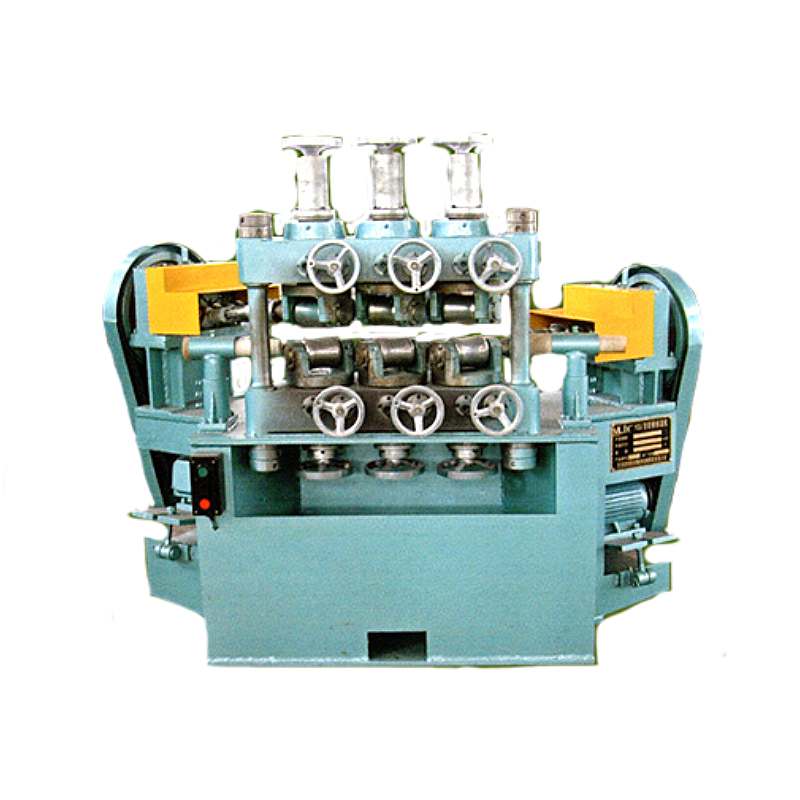
The development of pipe straightening machine
1. Early exploration (1930s-1950s) Application of pressure straightening machine In the 1930s, pressure straightening machine was mainly used for large steel straightening, using the principle of single reverse bending, but the efficiency is low and the operation is complicated. In 1938, Italy's LMP company first introduced the twin-screw extrusion technology into PVC pipe production, replacing the traditional hydraulic press process and laying the foundation of pipe processing equipment. In 1958, Qiaohunt developed the first industrial tension straightening production line, which realized the efficient straightening of aluminum strip and promoted the innovation of finishing technology.
2. Formation of the technological system (1960s-2000s) The inclined roller straightening machine has become popular. The six-roll/ten-roll inclined roller straightening machine has become the mainstream. The pipe is spirally advanced through the roller inclination (15-30), and the rolling and bending stress are combined to eliminate the multi-directional curvature. The principle of composite straightening is mature In the 1970s, the "bending + rolling" composite straightening model was established to improve the straightness and ovality simultaneously; Rolling system design is diversified (such as 222 type, 313 type) to meet different pipe diameter requirements. Major breakthrough in localization In 2008, CITIC Heavy Industry developed the world's largest JGL-920 ten-roll straightening machine, breaking the foreign monopoly and straightening pipe diameter up to Φ920mm Fourth, future trends Precision: the servo pressing mechanism can realize ±0.03mm micron level control; Unmanned: visual navigation correction system and automatic process chain integration; Low carbonization: the intelligent energy consumption management module reduces the unit energy consumption by more than 20%. Data verification: the blind area control of modern straightening machine is less than 400mm (50% less than traditional), and the heat straightening temperature resistance exceeds 700℃. The evolution of pipe straightening technology from mechanical pressure to intelligent composite straightening reflects the triple pursuit of precision, efficiency and sustainability in high-end manufacturing.
Straightening machine definition and function
1.The straightening machine is an industrial device designed to correct shape defects in metal profiles, such as bars, pipes, wires, and strips. By applying reverse bending force, tension, or a combination of these forces, the material undergoes plastic deformation to restore its straight shape. Its primary function is to eliminate non-linear deformations that occur during rolling, transportation, or processing.
2. Functions Eliminate shape defects: Correct defects such as bending, spooning (middle convex or concave), wavy (up and down edges), sickle bend (single side bending) and twisting to ensure that the material meets the specified straightness standard . For example, in the continuous casting process, the straightening machine can eliminate the bending deformation caused by uneven cooling of high temperature cast billet 3. Improving material properties: Optimized plate shape: the thin strip (such as aluminum plate) is stretched, bent and straightened to completely eliminate the three defects such as wavy edge and spooning, and significantly improve the flatness. Homogenized mechanical properties: eliminate the yield plateau of the material, prevent the formation of slip lines, and improve anisotropy during deep drawing (such as reducing the difference between the longitudinal and transverse yield limits of aluminum plates). Adapt to different working conditions: Roll straightening: suitable for conventional bars and tubes, through repeated bending of multiple rolls to achieve straightening. Stretch straightening: apply a tensile force beyond the yield limit for thin wall tubes or high precision aluminum Composite straightening: combining stretching and bending (such as stretching machine) can efficiently deal with the complex deformation of strip
Type and characteristics
Strain straightening machine: It is divided into vertical and horizontal types. Its working principle is to apply pressure to steel by using a movable press head and a fixed fulcrum, and straighten it through a single reverse bending method. This type of straightening machine has complex operation and low productivity, and is usually used for supplementary correction in large girder workshops 1. Roll straightening machine: This machine consists of upper and lower rows of correction rollers, a frame, and a transmission device arranged in an alternating pattern. As the steel passes through these rollers, it undergoes multiple bending cycles, resulting in straightening. This type of straightening machine is widely used for correcting strip steel and section steel, due to its high production efficiency and ease of mechanization, it is highly favored. Tension straightening machine (stretching straightening machine): This machine is used to correct thinner sheets. By applying a force exceeding the material's yield limit through two fixed jaws and one movable jaw, it causes plastic elongation, thus correcting the sheet. However, this method has a low production rate for single-sheet correction and results in significant waste at the ends. Stretching and bending straightening machine: It is developed on the basis of continuous stretching straightening machine and roller straightening machine, combining the advantages of both. It is mainly composed of two sets of tension rollers, a middle bending roller and a leveling roller, etc., which can effectively stretch and bend steel
Application scenarios and advantages and disadvantages Pressure straightening machine:
suitable for supplementary correction in large rail beam workshops, but the operation is complex and the productivity is low. Roll straightening machine: widely used in the correction of plate and strip steel and section steel, high productivity and easy to mechanize. Tension straightening machine: suitable for the correction of thinner plates, but low productivity and large metal loss. Stretch bending straightening machine: suitable for continuous operation line, low energy consumption and excellent correction quality
Maintenance of pipe straightening machine
1. Daily maintenance Clean management Clean the dust, oil and debris on the surface of the equipment in time to keep the output/input wheels, chains and other parts clean to avoid impurities affecting the straightening accuracy or heat dissipation 15. Clean the paint box after work (if applicable) to prevent the residue from solidifying and blocking the pipeline 6. Fastener inspection Check the bolts, screws and other connecting parts are loose every day, and tighten them in time to prevent the parts from moving or damage caused by vibration. Transmission system adjustment Check the tension of the belt regularly. Adjust it to an appropriate state when it is too loose to ensure effective power transmission.
2. Lubrication system management Regular lubrication The bearing should be cleaned and lubricated with grease at least twice a year, and the lubricating oil should be replenished periodically at each lubrication point to keep the mechanical operation flexible. The hydraulic oil/gear oil of the hydraulic station and reducer should be kept clean enough, and should be replaced every six months. The oil quality should meet the standard. High lubrication system maintenance (applicable to oil and gas lubricated models) Clean the Venturi tube regularly (2000 hours/ time is recommended), monitor the oil-gas mixture ratio (1:1500-1:2000) to ensure that the oil film is formed effectively. Seasonal oil switching: VG320 synthetic ester is used in summer, and VG220 mineral oil is used in winter, and the viscosity is adjusted according to temperature changes.
3. Inspection and replacement of key components Straightening roll maintenance Check the roll surface wear every week, and replace it immediately if the wear or damage is serious to avoid affecting the straightening quality. The working roll cooling water system should be checked every shift to ensure no leakage and normal water flow to prevent the roller surface from overheating and deformation. Durable parts monitoring Rust prevention brush, paint brush and other accessories should be replaced in time after wear to ensure the effect of rust removal and painting. Check the bearing temperature (≤60℃) and noise regularly, and stop for maintenance when abnormal.
4. Operation safety and specifications Start, stop and adjust Start sequence: first open the oil pump motor and then start the main motor; when stopping, the sequence is opposite . It is strictly prohibited to adjust the pressing device under load. The parameters must be set in the unloaded state . Feed requirements The steel pipe should be sent in flat at the end, and the hand holding position should be more than meter away from the head of the pipe to avoid injury. It is forbidden to straighten pipes with serious deformation, uneven thickness, burrs or double pipe overlap.
5. Fault prevention and handling exception response If abnormal sound, material jam or sudden stop occurs during operation, immediately press the emergency stop button and exit the pipe to investigate the cause. Straightening, embossing and abnormal temperature problems need to be stopped for maintenance to avoid damage expansion. Electrical and hydraulic systems Regularly check the grounding line and electrical control system to eliminate the risk of short circuit/leakage . The hydraulic system is checked for leakage every month and the aging sealing parts are replaced to ensure stable pressure .
6. Long-term maintenance plan Half year overhaul: including motor and reducer performance test, control system calibration, oil replacement. Intelligent monitoring application: configure pressure/flow sensor to provide real-time feedback on the status of the lubrication system, and optimize the maintenance cycle in combination with PLC data
How to choose the right pipe straightening machine?
1. Core parameter matching Pipe size Diameter range: the straightening machine should cover the minimum to maximum diameter of the pipe being produced (e.g. Φ10-200mm). Wall thickness adaptability: thin wall tubes (e.g., 0.8-3mm) should avoid excessive deformation, and thick wall tubes (e.g., 12mm) should be under higher pressure. Material characteristics: stainless steel, alloy steel and other special roll design and higher power support.
2.required precision Check whether the diameter of the pipe is within the straightening range, and cut off the bent head to avoid jamming.
What safety issues should be paid attention to when operating the pipe straightening machine
1. Personal protection and behavior norms armor Wear protective clothing, safety helmet and cut-resistant gloves. Do not wear ordinary gloves to operate rotating parts; The long hair should be put into the hat to avoid being caught in the equipment. Operation contraindications Do not adjust the roll gap, measure the workpiece or clean up debris when the equipment is running; Do not leave the post without authorization, and do not allow the body to approach the rotating roller or transmission parts 38.
2. Safety control during operation Standardize the operation process Steel pipes should be sent into the guide cylinder one by one (with 1 meter buffer pipe installed at the front end), and stacking is prohibited; According to the pipe diameter matching straightening block and transmission speed, thin wall pipe (such as wall thickness less than or equal to 0.8mm) needs low speed treatment. Dynamic monitoring Closely observe the pressure gauge and thermometer parameters. If the hydraulic oil temperature exceeds 70℃, stop the machine for cooling; Straighten 3-4 steel pipes and stop to check the size to prevent cumulative error.
3. Risk emergency response fault treatment When loading the material, power should be cut off immediately. It is strictly prohibited to pull the pipe forcibly with hands. Special tools should be used to eliminate it; In case of abnormal vibration or noise, stop maintenance immediately and do not run with disease. accident prevention When straightening the end, personnel should avoid the swinging area to prevent the steel pipe from popping out and injuring people; After the work is over, reset the roller, turn off the power supply and clean up the residual iron oxide.
4. Management of special working conditions High temperature pipe: the roller surface temperature should be monitored during hot straightening (≤700℃), and high temperature resistant rollers should be equipped; Explosion-proof environment: wet dust removal is prohibited in flammable dust places, and the ventilation system should be designed to be explosion-proof. Key data warning: Roll gap adjustment error should be controlled within ±0.03mm; If the abnormal current fluctuation of the equipment exceeds ±2%, the machine must be stopped. Through standardizing the operation process, strengthening protective measures and real-time risk control, accidents such as mechanical entanglement and object strike can be effectively avoided to ensure production safety.
summarize
Pipe straightening machine is stepping into the manufacturing industry step by step and becoming its unshakable flagpole. It is further improving in technology, cost, operation and working characteristics, etc., and will be unfathomable in the future

If you are interested in or wish to purchase this product, please visit our company website (www.suwaieheater.com) for a comprehensive selection of heaters and manufacturing machinery that can meet your needs. Our company has been specializing in the heating tube industry for 17 years and is a leading manufacturer and supplier. We are dedicated to addressing all customer concerns. If you have any questions, please feel free to contact us